Ask any engineer when they last used an Arduino. Most will tell you university, or an early hobby project, or a proof-of-concept built to understand a sensor before specifying the "real" hardware. The assumption is that Arduino is a stepping stone — something you use while learning, then leave behind when you cross over into professional engineering.
That assumption is increasingly wrong.
Arduino has developed a full industrial product lineup — the Arduino Pro family — that includes DIN-rail-mountable micro PLCs, industrial compute modules, and a proper IEC 61131-3 programming environment. These are not maker boards in industrial clothing. They are certified industrial devices, designed from the ground up for factory floor installation, running the same programming standards as the hardware your integrators have been specifying for decades.
Part 1: How Arduino Got Here
Arduino was founded in 2005 at the Interaction Design Institute Ivrea in Italy. The original goal was simple: make microcontroller programming accessible to designers and artists who had no electronics background. The board was open-source, cheap, and came with an IDE simple enough for a beginner to compile and upload their first sketch in under ten minutes.
It succeeded beyond any reasonable expectation. By the early 2010s, Arduino was in universities, makerspaces, and hobbyist workshops worldwide — the default starting point for anyone learning embedded systems.
But something else happened alongside the consumer success: engineers started using it professionally. Not for production machines — for prototyping. For quickly validating sensor interfaces. For building one-off monitoring tools. For testing communication protocols before committing to production hardware.
The reason was simple: the Arduino ecosystem — libraries, community support, documentation — made development faster than working with raw microcontrollers. An experienced engineer could wire up an I2C sensor, write the interface code, and have working data on a laptop in an afternoon. The same task on a bare microcontroller development kit might take two days.
Arduino noticed this. In 2019 they formally launched Arduino Pro — a separate product line explicitly targeting professional and industrial applications. The Arduino Opta, the Portenta family, and the associated industrial tooling are the result of that strategic decision.
Part 2: The Arduino Opta — A Micro PLC You Can Actually Spec
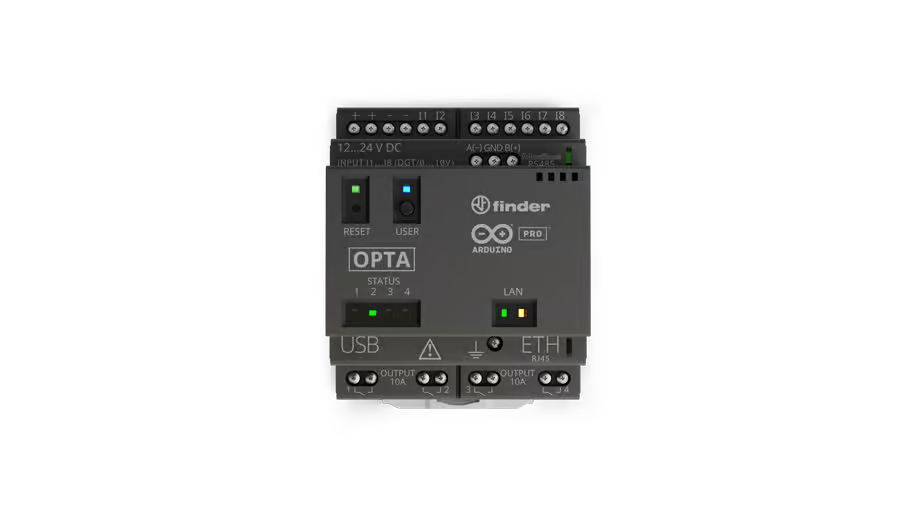
The Arduino Opta is the most immediately relevant product for anyone working in industrial machine control. It is a micro PLC — a small, self-contained programmable logic controller designed for DIN-rail installation in standard industrial control cabinets. It is not a development board. It is not a prototype platform. It is a finished industrial product with the certifications, environmental ratings, and I/O configuration of a proper industrial controller.
Hardware specifications
| Processor | STM32H747XI dual-core (Cortex-M7 at 480 MHz + Cortex-M4 at 240 MHz) |
|---|---|
| Memory | 2 MB flash, 1 MB RAM |
| Inputs | 8 configurable inputs — 0–10V analog or 24V digital, signal conditioning built in |
| Outputs | 4 relay outputs, 250V AC / 10A rated |
| Communication | 100 Mbit Ethernet, USB-C, RS-485 (Modbus RTU/TCP native) |
| Power supply | 12–24V DC (standard industrial) |
| Operating temperature | -20°C to +50°C |
| Enclosure | IP20, DIN-rail mountable — standard 35mm rail |
| Certifications | CE, UL, cUL |
| Cost | ~€100–€130 (vs €250–€350 for Siemens S7-1200 CPU 1211C) |
Programming
The Opta supports two distinct programming environments, and this is where it becomes genuinely interesting for professional engineers.
Arduino sketches — the familiar Arduino C++ environment, with access to the full Arduino library ecosystem. For engineers who know C++, this is a fast path to custom control logic, communication protocols, and data handling.
Arduino PLC IDE with IEC 61131-3 — a full IEC 61131-3 compliant environment supporting all five standard languages: Ladder Diagram (LD), Function Block Diagram (FBD), Structured Text (ST), Instruction List (IL), and Sequential Function Chart (SFC). A PLC programmer who has worked on Siemens, Schneider, or Beckhoff hardware can program the Opta without any learning curve on the programming side.
The ability to mix both environments — running Arduino sketch code alongside IEC 61131-3 programs — is genuinely novel. You can handle standard machine control logic in Ladder, write a custom Modbus communication routine in C++, and run both simultaneously on the same device.
Part 3: The Arduino Portenta Family — Industrial Compute Modules
The Portenta lineup addresses a different need: industrial-grade compute for embedding inside products, rather than standalone PLC functionality.
Portenta H7
The Portenta H7 is Arduino's flagship industrial compute module. It runs the same STM32H747 dual-core processor as the Opta, adding Wi-Fi, Bluetooth 5.1, a camera interface for machine vision applications, MicroSD storage, and a high-density connector for carrier board integration — all with industrial-temperature-rated components.
The H7 is designed for embedding inside a product. An OEM machine builder designs a carrier board specific to their application, plugs in the Portenta H7 as the compute core, and gains the processing power and Arduino ecosystem without designing a microcontroller circuit from scratch.
Portenta X8
The X8 takes this further, adding a full Linux environment (NXP i.MX 8M Mini running Linux) alongside the real-time microcontroller core. This mirrors the architecture of the RevolutionPi: a real-time control layer handles deterministic I/O, while Linux handles data processing, IIoT connectivity, and high-level application logic. Python, Node-RED, Docker containers, MQTT, and OPC-UA all run natively — no additional hardware, no protocol licenses.
Portenta Machine Control
The Machine Control carrier board pairs with the Portenta H7 to create a complete industrial controller: 3 analog inputs and outputs (0–10V or 4–20mA), 8 digital inputs and outputs (24V DC), 3 encoder inputs, CAN bus, RS-232/422/485, I2C, SPI — DIN-rail mountable, rated to -20°C / +50°C. A complete motion and process control hardware platform in a compact DIN-rail unit.
Part 4: The Software Ecosystem Advantage
One of the most compelling arguments for Arduino in industrial applications is the same argument that applies to Raspberry Pi: the software ecosystem is enormous, well-maintained, and almost entirely free.
There are over 5,000 Arduino-compatible libraries covering virtually every sensor, communication protocol, and peripheral you might need. I2C sensors, SPI displays, Modbus RTU, CANopen, MQTT clients, HTTP servers — the interface code is mostly written for you. This dramatically reduces development time compared to writing driver code from scratch in a proprietary PLC environment.
For sites that require IEC 61131-3 standard code — compliance or trained PLC teams — the Arduino PLC IDE provides full support. Code written in Structured Text follows an international standard. It is not vendor-specific. On the X8, Python, Node-RED, and standard Linux tooling run alongside real-time control code, giving data engineers and control engineers a common platform.
Compare this to a traditional PLC stack: proprietary development environments (TIA Portal, Studio 5000, Machine Expert) costing €500–€3,000 per seat; communication modules for each protocol; SCADA licenses. The licensing overhead alone can easily exceed €5,000–€10,000 for a fully-featured traditional PLC installation.
Part 5: Where Arduino Industrial Makes Sense
Arduino Pro products are not universal replacements for traditional PLCs. They are the right choice in some contexts and the wrong choice in others.
Where Arduino Opta excels
- Small standalone control applications — temperature control, simple sequencing, alarm monitoring, small conveyor control. The Opta handles these at a fraction of the hardware cost of a full PLC.
- Edge data collection — Ethernet and RS-485 connectivity at low cost means you can deploy one per machine without significant hardware budget impact.
- OEM machine builders with tight cost targets — the difference between a €350 Siemens CPU and a €130 Opta is €11,000 per year across 50 machines. Across a five-year product lifecycle, that is significant margin.
- Rapid prototyping — even if the production machine will use different hardware, prototyping on Arduino can compress development time meaningfully.
- Custom communication protocols — the ability to write C++ alongside IEC 61131-3 logic means implementing non-standard protocols is straightforward, without the limitations of a proprietary PLC's communication module ecosystem.
For a machine builder building 50 units per year, the difference between a €350 Siemens CPU and a €130 Arduino Opta is €11,000 per year in BOM savings. Across a five-year product lifecycle, that is a meaningful impact on product margin.
Where traditional PLCs remain the better choice
- Safety-rated applications (SIL 2/3) — Arduino Pro products do not carry functional safety certifications. For emergency stops and safety-critical I/O, a certified safety PLC remains necessary.
- Large I/O counts — the Opta's 8 inputs and 4 relay outputs suit small applications. For 64+ digital I/O and 16 analog channels, a traditional modular PLC is the appropriate choice.
- Formal vendor support agreements — automotive and pharma end users often require defined support response times and spare parts agreements. Arduino Pro offers professional support, but the infrastructure of Siemens or Rockwell is more established.
- Highly regulated industries with hardware validation processes — in pharmaceutical and nuclear applications, introducing new hardware requires formal qualification that takes months. Staying with previously-approved hardware is often the pragmatic choice.
Part 6: The Broader Lesson
Arduino's trajectory — from educational tool to professional industrial hardware — reflects something important about how engineering tools evolve. The properties that made Arduino useful for beginners (accessible, open, well-documented, affordable, large community) are not opposed to industrial use. They are, in many ways, exactly what industrial automation has needed for decades. Proprietary PLC ecosystems have been expensive, closed, and dependent on vendor relationships.
The same pattern is visible across the industrial computing space: Raspberry Pi Compute Module in the RevolutionPi, Linux becoming viable for real-time control with PREEMPT-RT, open-source SCADA platforms maturing to production quality. The direction of travel is consistent.
This does not mean proprietary industrial hardware is wrong or dying. It means the market is maturing, alternatives are becoming credible, and engineers have more legitimate options than they did ten years ago. The right response is to understand what each platform actually offers, match it honestly to the application requirements, and make a decision based on engineering judgement rather than habit.
Conclusion
Arduino is no longer just for beginners. It never stopped being for beginners — that accessibility remains a core value — but it has grown into a platform that professional engineers can specify with confidence for the right applications.
The Arduino Opta is a real micro PLC: certified, industrial-temperature rated, DIN-rail mountable, and programmable in IEC 61131-3. The Portenta family provides industrial-grade compute for embedded products. The ecosystem that surrounds them is deep, well-supported, and largely free.
For OEM machine builders with cost constraints, for edge computing applications, for rapid prototyping, and for small standalone control tasks — Arduino Pro deserves a place in your hardware shortlist alongside the established names.
The board you dismissed in your first internship has grown up. The question is whether your hardware evaluation process has too. If you're evaluating controllers for your next machine, we're happy to discuss what makes sense for your application.
Comments