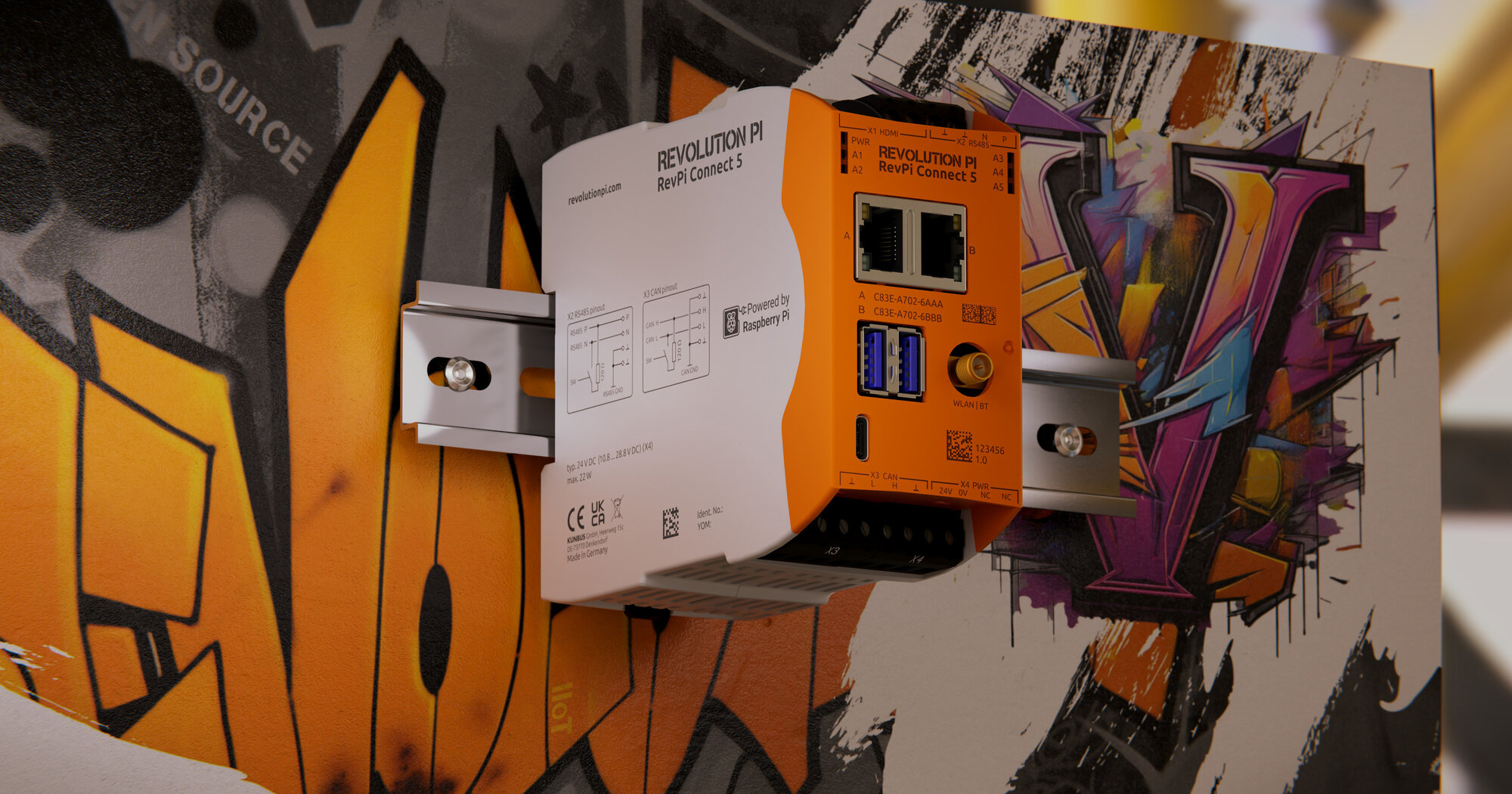
Most engineers hear "Raspberry Pi" and think hobby project. A weekend electronics kit. Something you'd use to build a weather station or a retro gaming console.
Put it in a DIN-rail housing, give it IEC 61131-3 compliance, add galvanically isolated I/O modules, and suddenly it's running a production line in a German factory. That's RevolutionPi from KunBus — and it deserves a serious look from anyone building or maintaining industrial automation systems.
What RevolutionPi Actually Is
RevolutionPi is a modular industrial controller built on the Raspberry Pi Compute Module. It runs a real-time-capable Linux OS and supports programming in CODESYS, Node-RED, Python, or C — your choice. Unlike a standard Raspberry Pi, it's designed from the ground up for industrial use: DIN-rail mount, IP20 enclosure rated for -40°C to +55°C, 24V DC power input, and a watchdog timer.
The I/O is handled through snap-on expansion modules — digital inputs, digital outputs, analog I/O, relay outputs — all galvanically isolated. The base unit communicates over PROFINET, EtherCAT, Modbus TCP, CANopen, and MQTT. It logs data locally, connects to SCADA systems, and pushes telemetry to cloud platforms.
This is not a dev board dressed up in an enclosure. It is a fully certified industrial controller with CE marking, a real-time kernel option, and an active global install base in manufacturing, energy, building automation, and research environments.
Why It Matters for Indian Projects
The traditional alternative for this class of application is a Siemens S7-1200, an NI CompactRIO, or a comparable mid-range PLC. A basic configuration of any of these starts at ₹1.5 to ₹3 lakh, before you account for programming software licenses, proprietary I/O modules, and vendor support contracts.
RevolutionPi comes in at a fraction of that cost. There is no vendor lock-in. The hardware is open, the software stack is Linux, and you're not dependent on a single distributor for spare parts or firmware updates.
- For OEM machine builders, this changes the unit economics significantly.
- For R&D teams building test rigs and data acquisition systems, it removes the budget barrier that often forces compromises on capability.
- For system integrators, CODESYS on Linux means the same IEC 61131-3 skillset carries over from any other major PLC brand.
Where It Has Been Used
RevolutionPi is in active deployment across test benches, edge data loggers, conveyor control systems, and process monitoring applications. KunBus reports installations across manufacturing, energy, building automation, and research environments globally.
The constraint in India isn't the technology — it's familiarity. Engineers who know the Siemens or Allen-Bradley ecosystem reach for what they know. But once a team has commissioned one RevPi project, the economics and flexibility make it very hard to go back to a proprietary platform for comparable applications.
The Bottom Line
If you are evaluating a controller for a machine that needs fieldbus connectivity, local data logging, remote monitoring, and programmable logic — and you don't want to pay for a brand name — RevolutionPi is worth a serious evaluation. It has the specs, the certifications, and the real-world deployment history to back it up.
Meekee supplies and supports RevolutionPi in India, including application consulting and commissioning support. If you're working on a project that could be a fit, reach out through our contact page or visit the RevolutionPi product page.
This post sparked a good discussion on LinkedIn — join the conversation here.
Comments