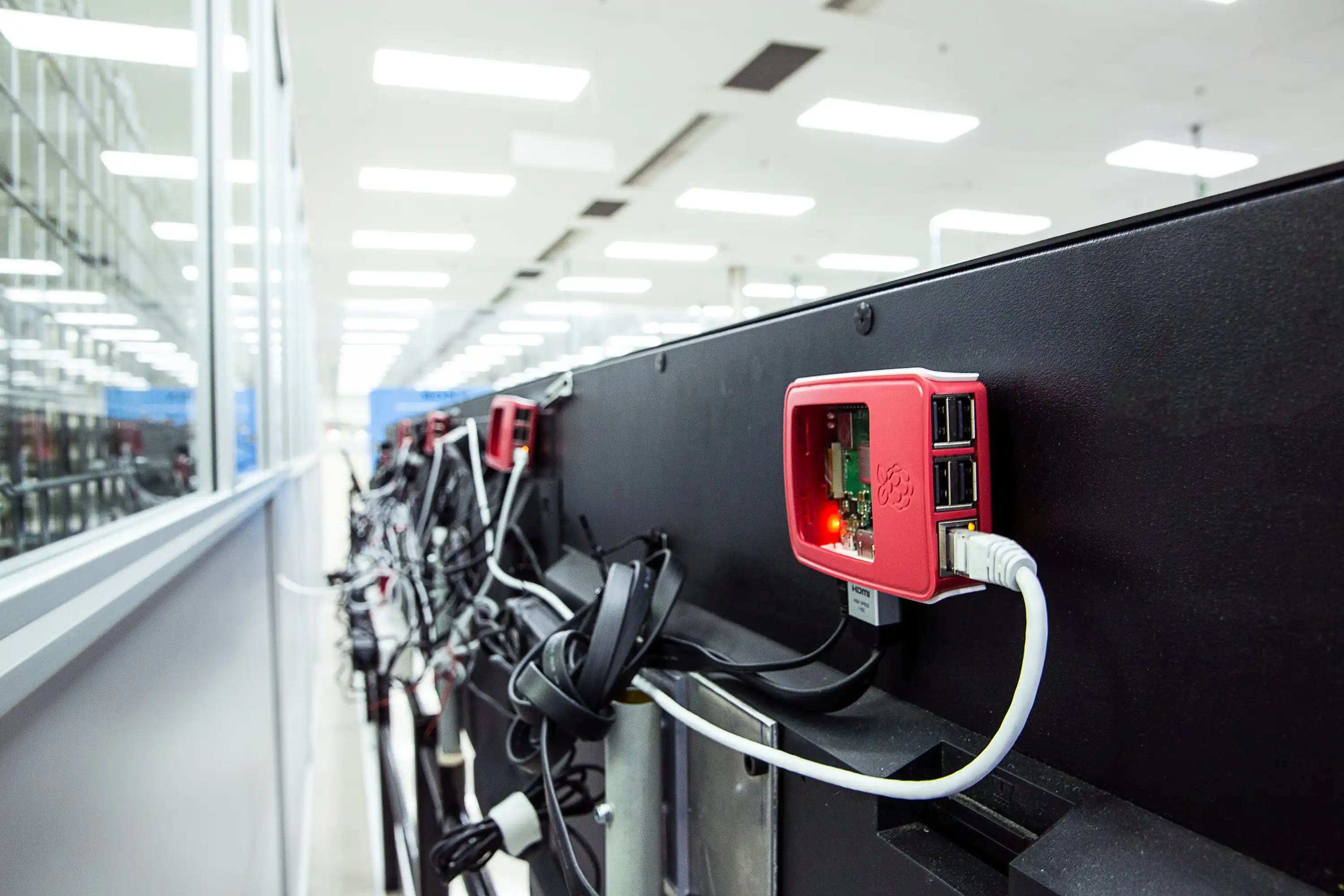
Raspberry Pi has an entire industrial division — raspberrypi.com/for-industry — and it has been quietly powering embedded products for over a decade. The misconception that Pi equals hobbyist is understandable. The foundation built its reputation by making powerful computing accessible to students and makers. But accessibility to beginners is not the same as unsuitability for professionals.
This article explains what Raspberry Pi for industry actually means, what hardware it involves, which real products are built on it, and why it is now a legitimate — and in many cases superior — platform for industrial machine control.
Part 1: The Compute Module — Pi's Industrial Form Factor
The standard Raspberry Pi board that most people know — the credit-card sized PCB with USB ports, HDMI, and a 40-pin GPIO header — is designed for accessibility. It is easy to connect to, easy to prototype with, and deliberately exposed.
That form factor is not suitable for embedding inside a machine. The connectors are fragile, the board has no protection, and the layout is designed for flexibility rather than compactness or reliability in a vibration-prone environment.
Raspberry Pi recognised this early and introduced the Compute Module — a stripped-down version of the Pi's core silicon and memory, packaged onto a smaller board designed specifically for embedding inside products.
The Compute Module (currently CM4 and CM5) contains:
- The same BCM2711 or BCM2712 processor as the full Pi
- RAM (options from 1 GB to 8 GB)
- eMMC flash storage (or provision for external SD/NVMe)
- All core interfaces: PCIe, USB, camera, display, GPIO, I2C, SPI, UART
What it does not have: USB ports, HDMI ports, Ethernet jacks, or a 40-pin header sticking out. Those are left to the carrier board — the custom PCB that the product manufacturer designs around the Compute Module.
Raspberry Pi provides the computing core, certifications, and long-term supply commitment. The manufacturer wraps it in the appropriate industrial enclosure, I/O, and connectivity for their specific application. This is exactly how the RevolutionPi, Seeed Studio's industrial Pi products, and numerous other embedded industrial computers are built.
Part 2: What "Industrial Grade" Actually Means
When engineers hear "industrial grade," they think of specific, measurable properties. Here is how Pi-based industrial products actually compare.
Operating temperature range
Consumer electronics are typically rated to 0°C–70°C. Industrial equipment is commonly rated to -20°C–+60°C or wider. The Raspberry Pi Compute Module 4 is rated for an industrial temperature range of -40°C to +85°C — well within what most factory floor applications require.
Supply voltage
Standard Pi boards run on 5V USB. Industrial environments run on 24V DC — the standard for control cabinets across almost all industrial markets. Industrial Pi carrier boards include the appropriate power conditioning circuitry to run from 24V rail power directly. No wall adapters, no USB cables inside a control cabinet.
Vibration and shock resistance
The Compute Module is a small, low-profile board with no large connectors or heavy components that can work loose. Industrial carrier board manufacturers design their enclosures and mounting systems to meet relevant vibration standards. Many industrial Pi products are DIN-rail mountable — mechanically secured rather than resting on a surface.
Long-term availability
This is one of the strongest arguments for the Compute Module in industrial applications. Raspberry Pi has committed to long production lifetimes for the Compute Module — 10+ years is the stated target. For a product manufacturer embedding it inside a machine that might be in service for 15–20 years, supply continuity matters enormously. This is a point where many competing single-board computers fall short.
EMC and certifications
Raspberry Pi Ltd. provides compliance documentation through their Product Information Portal for the Compute Module. End-product manufacturers add their own CE, UL, or other certification as required. Several commercial industrial Pi products — including the RevPi series — carry CE marking for the European market.
Part 3: Real Industrial Applications — Where Pi Is Already Running
Raspberry Pi's industrial page highlights several real-world applications that illustrate the platform's range.
Space and satellites. CubeSat manufacturers have used Raspberry Pi Compute Modules for satellite payloads. The requirements — radiation tolerance, reliable operation in extreme thermal conditions, low power draw — are among the most demanding in any engineering discipline.
HP printing presses. HP has used Raspberry Pi technology in industrial printing press control systems. A printing press is a demanding industrial environment: high speed, high precision, continuous operation, and no tolerance for unplanned downtime.
Autonomous vehicles. MDM Team, a robotics and autonomous vehicle developer, uses Raspberry Pi in vehicle control and perception systems — applications requiring deterministic real-time behaviour, reliable sensor interfacing, and robust operation across environmental conditions.
The pattern across these applications is the same: the Compute Module provides a well-understood, well-documented, long-lifetime computing core, and the product manufacturer builds the application-specific hardware around it.
Part 4: RevolutionPi — Pi on the Factory Floor
The most relevant implementation of industrial Pi for machine control applications is the RevolutionPi by KUNBUS GmbH, a German industrial automation company.
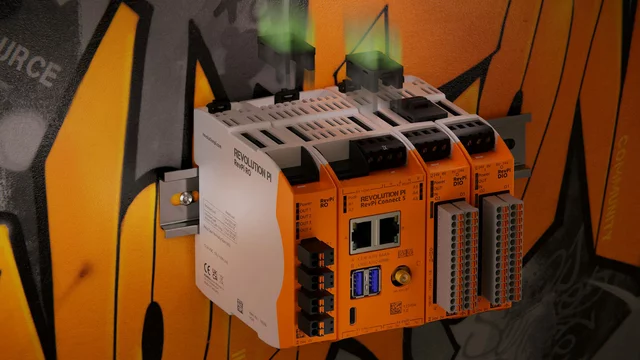
RevolutionPi takes the Raspberry Pi Compute Module and packages it into a DIN-rail-mounted industrial controller designed specifically for factory floor installation. It mounts on a standard 35mm DIN rail — the same rail that carries your MCBs, power supplies, and terminal blocks. There is nothing unusual about commissioning or installing it from a panel builder's perspective.
pibridge — the industrial backplane
The defining feature of the RevPi system is pibridge — a proprietary backplane bus that connects multiple RevPi modules side by side. Through pibridge, you can add digital I/O modules, analog I/O modules, and fieldbus gateway modules for CANopen, Profibus DP, Modbus RTU/TCP, EtherCAT, and PROFINET. The pibridge operates at 200 Hz — sufficient for servo press controllers with encoder feedback and analog force sensor input across the vast majority of pressing, crimping, and force-controlled assembly applications.
CODESYS runtime
The RevolutionPi supports the CODESYS runtime — the same IEC 61131-3 compliant programming environment used by Siemens, Beckhoff, Schneider, and the majority of professional PLC manufacturers. A PLC programmer already familiar with CODESYS can program a RevPi using ladder logic, function block diagrams, or structured text — exactly as they would on a traditional PLC.
Linux underneath everything
What makes the RevPi genuinely different from a traditional PLC is that CODESYS runs on top of a real Linux operating system. The Linux layer is always running alongside CODESYS. This means:
- Python scripts, Node.js services, or any Linux application run alongside your PLC program
- Node-RED, MQTT brokers, OPC-UA servers, and other IIoT middleware run natively — no additional hardware, no protocol licenses
- SSH into the device for remote diagnostics
- Write data to files, databases, or cloud endpoints using standard Linux tools
- Any standard monitor connected via HDMI becomes an HMI — no proprietary display hardware required
None of this is available on a traditional PLC without purchasing additional hardware modules or software licenses.
Specs at a glance
| Supply voltage | 24V DC (standard industrial) |
|---|---|
| Operating temperature | -20°C to +55°C |
| Enclosure | IP20 — suitable for control cabinets |
| pibridge cycle | 200 Hz (5 ms) |
| Programming | CODESYS (IEC 61131-3), Python, Node-RED |
| Certification | CE marked |
| Cost (Connect 4) | ~€200–€300 (vs €500–€800 for Siemens S7-1200) |
Part 5: The Software Ecosystem Advantage
The Raspberry Pi platform has one of the largest developer communities of any computing platform in the world. The tooling ecosystem is enormous, well-documented, and almost entirely free.
CODESYS — IEC 61131-3 PLC programming. Runtime licenses are included in the RevPi hardware cost. Node-RED — flow-based IIoT programming. Runs natively on Linux. Free. InfluxDB + Grafana — time-series database and dashboarding. Collect every press cycle's force-displacement data and display trending dashboards in real time. Free. MQTT / OPC-UA — standard industrial protocols with open-source implementations. No communication module licenses required.
Compare this to a traditional PLC ecosystem: proprietary development environments (TIA Portal, Studio 5000, Machine Expert) that cost €500–€3,000 per seat; communication modules for each protocol; SCADA licenses for data collection. The licensing overhead alone can easily exceed €5,000–€10,000 for a fully-featured traditional PLC installation.
Part 6: The Objections — and the Honest Answers
"It's not a real PLC. It won't be supported by our machine supplier."
The relevant question is not "is it a PLC?" but "does it run IEC 61131-3 standard code?" RevPi with CODESYS does. Code written in standard structured text or function block diagrams on RevPi is portable to any CODESYS-compatible platform.
"What about cybersecurity? A Linux device is more exposed than a PLC."
This is a real consideration. A Linux device has a larger attack surface if not hardened properly. The correct response is to apply standard Linux hardening: disable unused services, use a firewall, apply security patches regularly, and use a VPN for remote access. Traditional PLCs are not inherently more secure — many have no authentication on their programming interfaces at all.
"We need deterministic real-time control. Linux isn't real-time."
Standard Linux is not a real-time operating system. However, with the PREEMPT-RT patch (which RevolutionPi applies), Linux achieves sufficiently deterministic behaviour for most industrial control applications. The pibridge at 200 Hz — a 5 ms cycle time — is deterministic and sufficient for servo press, motion control, and most manufacturing automation tasks. Applications requiring sub-millisecond hard real-time should use a dedicated RTOS — but these represent a small minority of industrial applications.
Part 7: What This Means for Smaller Manufacturers
The traditional industrial automation stack — Siemens PLC, Weintek HMI, PROFINET network, SCADA license — is the default for large manufacturing operations because they have the budget, the trained staff, and the vendor relationships to support it.
For smaller manufacturers, OEM machine builders, and startups building new machines, this stack is often disproportionately expensive relative to the application's actual requirements.
A servo press controller for a 10-tonne automotive crimping press does not need a €2,000 Siemens CPU. It needs reliable real-time control at 200 Hz, force and position feedback, data logging for traceability, and a usable operator interface. A RevPi running CODESYS delivers all of this at €300.
The cost difference — €300 vs €1,500+ — at the machine level may seem modest. Across a production line of 20 machines, it becomes €24,000 in hardware savings, before factoring in HMI hardware, SCADA licenses, and communication modules.
Conclusion: The Pi Is Not a Toy. It Never Was.
The Raspberry Pi earned its reputation by making powerful computing accessible. That accessibility is sometimes read as a lack of seriousness — a board for students, not for engineers building real machines.
The reality is that the same properties that make Pi accessible to beginners — open software, deep documentation, enormous community support, long supply commitment, and low cost — make it genuinely compelling for industrial applications when wrapped in the appropriate industrial hardware.
The Compute Module in a RevPi enclosure, running CODESYS with a pibridge at 200 Hz, with Linux underneath for data logging, IIoT, and remote access, is not a compromise. It is a considered architectural choice that trades proprietary ecosystem lock-in for openness, flexibility, and cost efficiency.
If you are evaluating a controller for a machine that needs fieldbus connectivity, local data logging, remote monitoring, and programmable logic — and you don't want to pay for a brand name — RevolutionPi is worth a serious evaluation. Reach out to discuss your application.
Comments