For years, National Instruments CompactRIO has been the default choice for high-performance industrial control in research labs, test systems, and mid-complexity automation. It's capable, well-documented, and carries the weight of NI's brand. It also carries NI's price tag — and their proprietary toolchain.
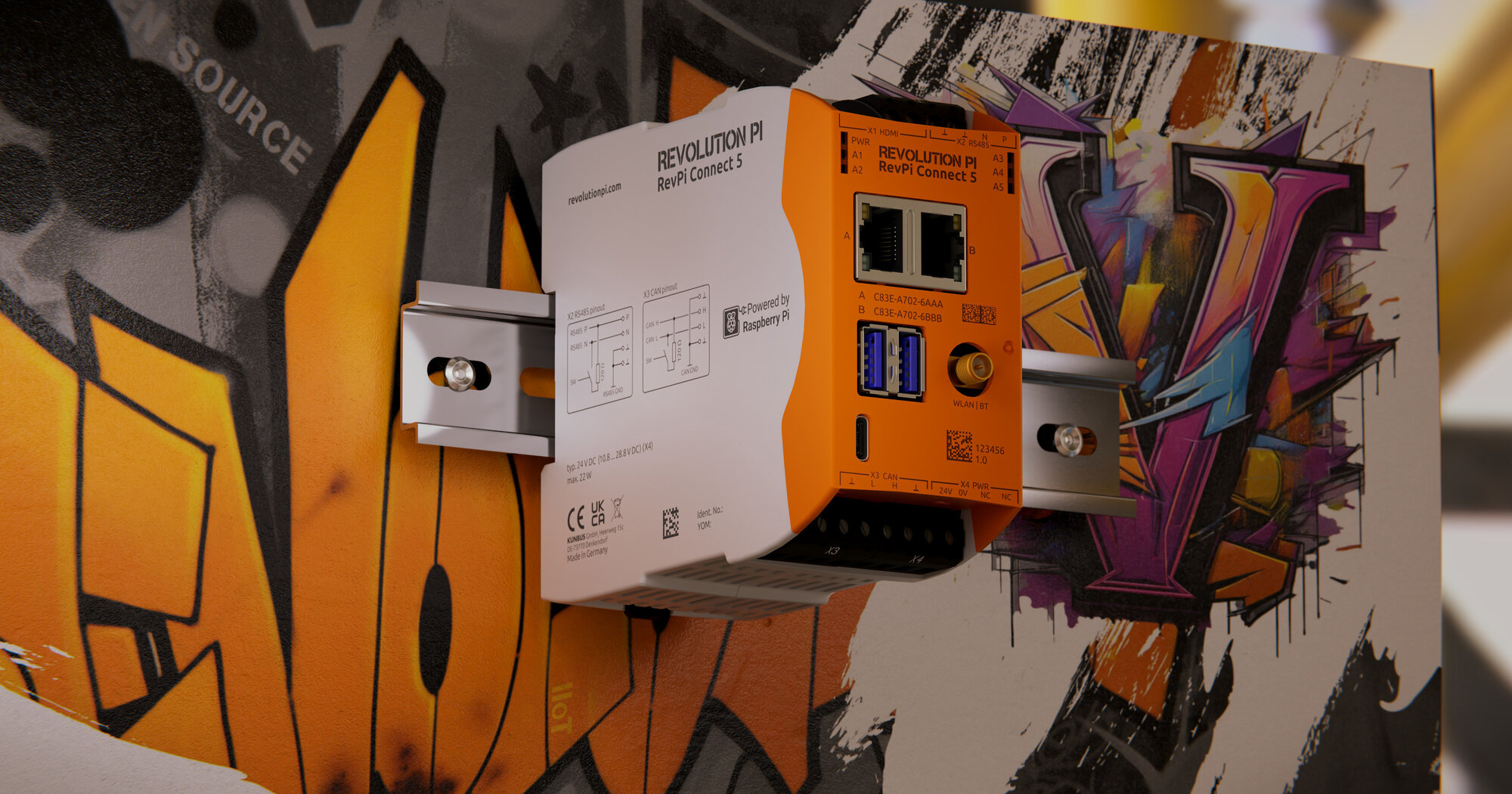
RevolutionPi, built by KunBus on a Raspberry Pi Compute Module, takes the opposite approach: open Linux, standard industrial interfaces, IEC 61131-3 via CODESYS, and hardware priced for production budgets. We've deployed both on customer projects. Here's what we've learned.
Platform Architecture
CompactRIO runs on a real-time processor paired with a reconfigurable FPGA (Xilinx). The FPGA is the key differentiator — it allows deterministic I/O processing at nanosecond timing and custom hardware logic without external components. LabVIEW is the primary development environment, with C/C++ available via the Real-Time module.
RevolutionPi runs Linux on a Raspberry Pi Compute Module 4 (CM4). The real-time layer is handled either by a dedicated CODESYS runtime or by a patched RT Linux kernel. I/O expansion happens through the PiPlate bus — a DIN-rail ecosystem of digital I/O, analog I/O, gateway modules (Modbus, PROFINET, EtherCAT), and relay cards that clip directly onto the base unit.
Key distinction: If your application requires custom hardware timing at sub-microsecond resolution or FPGA-level signal processing, CompactRIO's integrated FPGA gives you capabilities RevolutionPi cannot match. For the vast majority of industrial control tasks — PLC logic, motion coordination, SCADA integration, data logging — RevolutionPi is more than sufficient.
Head-to-Head Comparison
| Category | RevolutionPi Connect 5 | NI cRIO-9045 |
|---|---|---|
| Processor | Raspberry Pi CM4 (ARM Cortex-A72, 1.5 GHz, quad-core) | Intel Atom E3930 (1.3 GHz, dual-core) + Xilinx Artix-7 FPGA |
| OS / Runtime | Linux (Debian/Raspbian), RT Linux optional, CODESYS runtime | NI Linux Real-Time OS, LabVIEW RT |
| Programming | CODESYS (IEC 61131-3), Python, Node-RED, C/C++ | LabVIEW RT + LabVIEW FPGA (proprietary), C/C++ via NI SDK |
| I/O expansion | PiPlate bus — DI, DO, AI, AO, relay, gateway modules (DIN-rail) | C-Series modules — extensive range, hot-swappable |
| Fieldbus support | PROFINET, EtherCAT, Modbus TCP/RTU, CANopen, OPC-UA (via modules) | EtherNet/IP, PROFINET, Modbus (varies by module) |
| FPGA | None | Xilinx Artix-7 — custom deterministic I/O logic |
| Connectivity | 2x Gigabit Ethernet, USB 3.0, USB-C, HDMI, RS-485 | 2x Gigabit Ethernet, USB 2.0 |
| Approx. hardware cost (India) | Rs. 25,000 – 45,000 (base unit) | Rs. 3,50,000 – 6,00,000+ (base unit) |
| Software licensing | CODESYS runtime included; open-source tools free | LabVIEW licenses: Rs. 1,50,000 – 4,00,000+ per seat/year |
| Vendor lock-in | Open standards — switch integrators freely | High — LabVIEW skills and NI toolchain required |
| CE / UL / IP rating | CE marked, IP20 (DIN-rail) | CE, UL, cUL marked, IP20 (chassis) |
| India availability | In-country stock via Meekee (Chennai) | Import only — 4–12 week lead times typical |
Programming Environment
This is where the practical difference is most felt. LabVIEW is a graphical dataflow language — powerful for signal acquisition and test systems, but with a steep learning curve for engineers from a PLC or software background. Hiring LabVIEW engineers in India is difficult, and licensing is expensive.
RevolutionPi uses CODESYS, which implements IEC 61131-3 — the same standard used by Siemens, Beckhoff, Schneider, and most European PLC vendors. If your team knows Ladder Diagram, Structured Text, or Function Block Diagram, they can program RevolutionPi immediately. You can also run Python scripts, Node-RED flows, or C programs alongside the CODESYS runtime on the same hardware.
Real-Time Performance
CompactRIO's FPGA gives it deterministic timing that RevolutionPi cannot match out of the box. For applications like high-speed encoder counting, hardware-timed analog acquisition at 100 kHz+, or custom PWM generation, the FPGA is genuinely necessary.
For standard industrial PLC tasks — cycle times of 1–10 ms, motion coordination, SCADA comms, data logging — RevolutionPi with the CODESYS runtime or an RT Linux kernel runs reliably within these bounds. The Connect 5's CM4 processor handles concurrent tasks comfortably without the FPGA.
Total Cost of Ownership
This is where the comparison becomes stark for Indian projects. A cRIO-9045 with three C-Series I/O modules costs roughly Rs. 5–7 lakh in hardware alone. Add LabVIEW RT and FPGA software licenses (annual subscription), and a two-seat development setup for a 3-year project can exceed Rs. 20 lakh in software costs alone.
A RevolutionPi Connect 5 with equivalent I/O via PiPlate modules costs Rs. 60,000 – 1,20,000 in hardware. CODESYS runtime is included. Python, Node-RED, and Linux tools are free. Over a 3-year project, the TCO difference is often 5–10x.
India-specific note: NI hardware imported into India attracts customs duties and GST that further inflate the landed cost. RevolutionPi stock held locally by distributors like Meekee ships with a standard GST invoice, no import delay, and in-country warranty support.
When to Choose CompactRIO
- Your application genuinely requires FPGA-level determinism (sub-microsecond timing, custom I/O logic)
- You are integrating with an existing NI test infrastructure and LabVIEW codebase
- You need NI's C-Series module ecosystem for specialised measurement (strain gauge, thermocouple arrays, high-speed DAQ)
- Your customer mandates NI hardware for contractual or certification reasons
When to Choose RevolutionPi
- You need a production-grade Linux PLC without proprietary lock-in
- Your team programs in IEC 61131-3, Python, or standard Linux environments
- Budget is a primary constraint — hardware or software cost needs to be minimised
- You need PROFINET or EtherCAT fieldbus without expensive add-on modules
- You want in-country stock, local support, and GST-compliant procurement
- You are building a multi-unit deployment where per-unit hardware cost matters
Conclusion
CompactRIO is excellent hardware — but it solves a problem that most industrial automation projects don't have. RevolutionPi covers 90% of real-world PLC requirements at a fraction of the cost, with an open software stack your team can own and maintain without vendor dependency.
For most Indian OEMs, manufacturers, and research labs, RevolutionPi is the better starting point. If your application genuinely needs the FPGA, CompactRIO is still the right choice — but that requirement is less common than NI's marketing might suggest.
If you're evaluating which platform fits your specific application, reach out to us — we're happy to do a technical assessment at no charge.
Comments