I've had this conversation more than once with automation engineers evaluating servo press controllers.
"We need at least 1000 Hz control loop. Anything less isn't real-time enough."
It sounds reasonable. Faster is better, right?
Not always. And in the case of most industrial pressing applications, the obsession with loop speed is costing teams flexibility, money, and capability they don't even realise they're giving up.
Let me explain — with actual numbers.
What does a 200 Hz control loop actually mean?
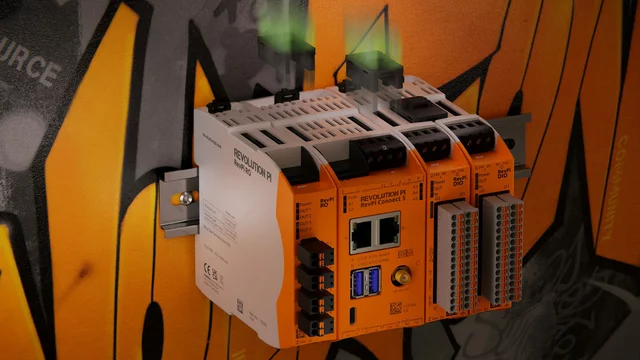
200 Hz means your controller reads sensors and updates outputs every 5 milliseconds. The RevPi Connect running CODESYS via pibridge operates at exactly this speed — and it's a real industrial platform, not a hobbyist board.
Here's why 5 ms is enough: the mechanical dynamics of a pressing operation play out over tens to hundreds of milliseconds. A crimping cycle typically takes 80–150 ms. A rivet press completes in 150–250 ms. Pharma tablet compression runs at 100–300 ms per cycle.
A 5 ms control loop samples and corrects a force curve with sub-2% error across all of these profiles. The motor, the drive, and the mechanical system simply don't respond fast enough to make a 1 ms loop matter in practice.
The applications that genuinely need sub-millisecond control — semiconductor wire bonding, ultra-precision micro-assembly, high-speed grinding — are a small fraction of industrial automation. For the other 80%+: 200 Hz is more than sufficient.
So why do people spec 1000 Hz?
Mostly because PLC vendors put it on the datasheet, and it sounds like a differentiator.
And yes, if you're running a dedicated motion controller on a high-end PLC platform, you can hit 1 ms cycle times. But here's what nobody tells you about what you give up when you go PLC to chase that number:
1. Your HMI costs extra
On a PLC platform, a touchscreen HMI is a separate hardware purchase — ₹20,000 to ₹1,20,000 depending on size and brand. On a RevPi or any IPC, plug in a standard monitor. That is your HMI. Use a ₹6,000 office screen. Done.
2. Data logging is an afterthought
PLC data logging requires expensive add-on modules or proprietary SCADA licenses. On an IPC running CODESYS, you're on a Linux system with full file access. Log every press cycle to CSV, SQLite, or InfluxDB — natively, for free. Full force curves. Position profiles. Timestamps. No extra cost.
3. IIoT connectivity costs a license on PLC. On IPC, it's free.
Want MQTT or OPC-UA on a PLC? Budget for the communication module and the protocol license. On a RevPi running Linux alongside CODESYS, Node-RED installs in 2 minutes. MQTT broker runs in the background. You can push press data to cloud dashboards, trigger alerts, connect to ERP — all without paying a vendor ₹50,000 for a stack that should be free.
4. Real-time graphs without a SCADA layer
On an IPC, your control software can display live force/position curves on the connected monitor. The operator sees every press cycle in real time. On a PLC, this requires a separate SCADA layer — more hardware, more licensing, more integration work.
5. Configuration that any engineer can change
On a PLC, modifying a process parameter means editing ladder logic, recompiling, and pushing a new program — PLC programming skills required. On an IPC, your configuration can be a simple table: the process engineer types in the target force, saves it, and it's live. No programmer needed for routine adjustments.
6. Remote access is built-in
IPC runs Linux. SSH, VNC, or a VPN session is native. Your support engineer can diagnose a pressing fault in Mumbai from Chennai without travelling. On a PLC, remote access is a dedicated hardware module — another line item on the BOM.
The real trade-off
The question shouldn't be "what's the loop speed?"
It should be: "Do I need 1000 Hz, or do I need 200 Hz + HMI + data logging + IIoT + real-time graphs + easy configuration — all in one box, at a fraction of the cost?"
For most automotive component makers, pharma companies, and OEM machine builders, the second option delivers more operational value. By a significant margin.
The 1 ms cycle time impresses in a presentation. But in practice — the operator who can see force curves on a monitor, the engineer who pulls six months of press data to trace a quality issue, the plant manager who checks machine status from their phone — those are the capabilities that actually improve a manufacturing line.
What we're building at Meekee
At Meekee, our servo press controller runs on an IPC platform for exactly this reason. The RevPi Connect with CODESYS via pibridge gives us a solid 200 Hz real-time control loop — enough precision for the vast majority of pressing, crimping, and compression applications. And because it's IPC-based, everything else comes standard: local HMI on any monitor, native data logging, open IIoT connectivity, and a configuration interface that doesn't require a PLC programmer to operate.
The customers most frustrated with their existing systems weren't losing precision because the loop was too slow. They were losing time because data was locked away, configuration required a specialist, and every HMI upgrade was a separate project.
Fixing those problems doesn't require a faster loop. It requires the right architecture.
The bottom line: Before specifying a high-end PLC for your next servo press application, ask one honest question: what percentage of my real operational problems are caused by a 5 ms control loop being too slow?
If the answer is "none of them" — then you're paying PLC prices to solve a problem you don't have, while giving up the capabilities that would actually make a difference on the shop floor.
200 Hz is enough. What you build around it is what separates a good system from a great one.
Have a pressing application you'd like to think through? Get in touch — we're happy to work through the architecture with you.
Comments